Colonial Medical Supply
Colonial Medical Supply
Tel: 603-404-2105
Toll-free: 888-446-8427
Fax: 603-404-2138
Ophthalmology
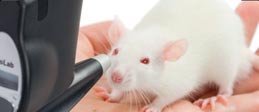 Icare TONOLAB
Tonometer specifically designed to obtain the IOP in mice & rats
- Does not require the use of topical anesthetic
- Handheld mobile tonometer that has the latest IOP measurement technology for the screening of glaucoma
- Has been developed for the animal health field
- New probe technology that prevents cross contamination
- There is no risk of microbial contamination, as one-use probes are used in the measurement
- Screening is fast, effective and reliable with documented accuracy
- The Icare TONOLAB is designed to take and calculate the average of six measurements, each taken in a fraction of a second, reducing the influence of factors outside of the eye.
- The Icare TONOLAB tonometer is used in the diagnosis, follow up, and screening of glaucoma
- The Icare TONOLAB is based on the new patented induction based rebound method which allows intraocular pressure (IOP) to be measured accurately, rapidly, and with out a local anesthetic
- Part # TL -1
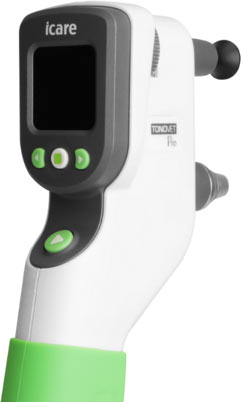 Icare TONOVET Pro
The new Icare TONOVET Pro has improved features e.g. advanced user interface with clear, bigger display facing the user. More forgiving angle position to assist with ease of obtaining correct readings. Automatic measuring sequences. Use for all animal other than rodents. Dedicated mode for dog, cat, rabbit and other.
Part # TV0031-234
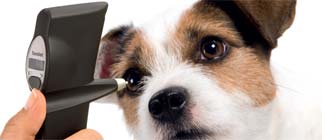 Icare TONOVET® for animals
The tonometer is intended for use by general veterinary practitioners, veterinary ophthalmologists and other veterinary medical personnel. The device is a useful tool for measuring intraocular pressure on animal patients, as it is painless and therefore creates no anxiety.
The tonometer is based on a new measuring principle, in which a very light probe is used to make momentary contact with the cornea. The measurement is barely noticed by the animal and often does not even cause corneal reflex.
Part # TV -1
Advantages of the Icare tonometers:
- Non-invasive measurement with minimal discomfort to the subject.
- The rapid IOP measurements, are instantly display in mmHg.
- The tonometer requires no calibration and features species specific modes for rats and mice.
- The risk of microbiological cross contamination is eliminated with a single use probe.
- The time needed from induction to the instrument to the results of dependable consistent readings is minimal.
- The menu is simple and user friendly providing the researcher with an instrument that is unique, reliable and accurate.
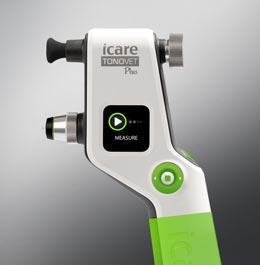 Icare TONOVET Plus
The new Icare TONOVET Plus is even easier to use than it's successor. It features e.g. advanced user interface with clear, bigger display. Red/ green positioning lights help to find the correct angle and to aim to the middle of the cornea. Automatic measuring sequence let's you choose if you want to take single readings or take all 6 measurements by one press only.
Part # TV-1-P
Accessories
| Icare TONOLAB | |
|---|---|
| #TLP | Box of replacement probes, 100 count |
| #TB | Replacement probe base |
| Icare TONOVET | |
| #TVP | Box of replacement probes, 100 count |
| #TB | Replacement probe base |